
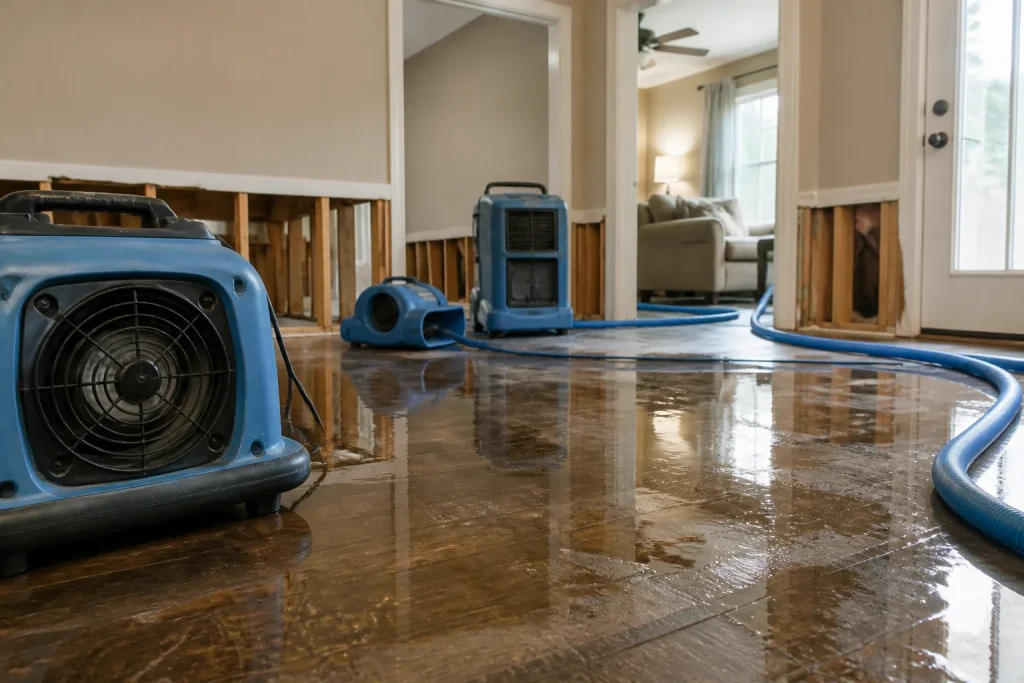
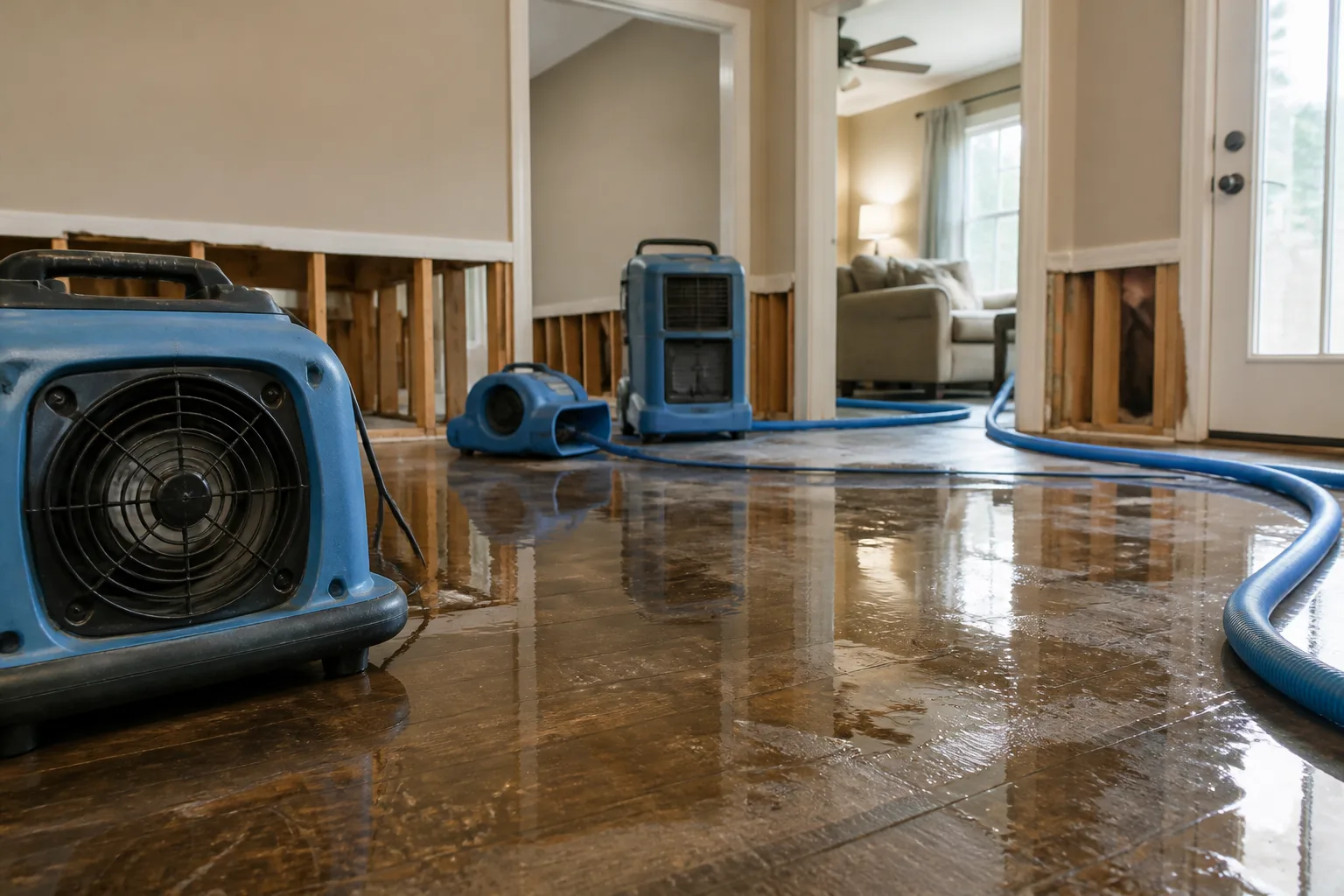
Injectidry Water Damage Restoration in Rancho Cucamonga: A Homeowner’s Guide
Injectidry systems dry wall cavities and hardwood floors from the inside out using negative air pressure, which often saves building materials that would otherwise be ripped out and replaced. In Rancho Cucamonga, where summer temperatures regularly push past 95°F and indoor relative humidity can hover below 20%, the system works exceptionally well because dry ambient air accelerates evaporation once moisture is pulled from inside the structure. If you’re facing water damage right now and want a straight answer on whether your walls or floors can be saved, call (844) 716-1094 for an assessment.
Here’s what most homeowners don’t hear until it’s too late: a contractor who shows up with an Injectidry system isn’t automatically doing it right. The drying panels must be placed at calculated intervals based on material permeability and moisture readings, not just wherever they fit on the wall. This guide explains exactly how the system works, what the moisture numbers mean, and how to tell if your restoration contractor actually knows what they’re doing.
Key Takeaways
- Injectidry uses negative pressure to pull moisture from inside wall cavities without automatic demolition.
- Moisture content thresholds determine whether drying is viable or tear-out is unavoidable.
- Hardwood floor drying panels work differently than wall panels, and Rancho Cucamonga’s dry climate helps.
- Daily moisture logs should show consistent drops. If they don’t, the scope needs to change.
- Insurers increasingly expect Injectidry on qualifying jobs because it reduces unnecessary rebuild costs.
What the Injectidry System Actually Does
The Injectidry HP-60 and its panel attachments create a sealed vacuum against a wall or floor surface. A hose runs from the panel to a powerful pump that pulls air through the material and out of the cavity. That’s the core physics: air moves from high pressure to low pressure, and the system reverses the natural path moisture would take as it sits trapped inside drywall, insulation, or hardwood. Instead of letting water linger and feed mold, the Injectidry forces continuous airflow through the affected material until it reaches an acceptable moisture content.
Here’s why that matters in practice. Traditional drying uses air movers and dehumidifiers pointed at surfaces. That works fine for exposed materials. It does almost nothing for the back side of drywall or the subfloor under hardwood. Without cavity drying, a restoration contractor has two options: wait weeks and hope mold doesn’t take hold, or tear out the drywall and insulation to expose the wet cavity. Injectidry gives a third option. We’ve used the HP-60 system on Rancho Cucamonga jobs where water traveled from a second-floor bathroom leak down through first-floor ceiling cavities. The drywall looked bad from the outside, but moisture mapping showed the structural framing was sound. The panels pulled the trapped water out through the drywall itself, and the homeowner kept ceilings that would have otherwise gone to the dumpster.
This is IICRC-certified drying protocol in practice, not guesswork. The system only works when technicians understand vapor pressure, material permeability, and airflow dynamics. That’s the difference between a restoration company and a general contractor with a wet vac. If you want a deeper look at how this fits into full-scale water damage work, see our Water Damage Restoration in Rancho Cucamonga page.
When Injectidry Works and When Demolition Is Unavoidable
The system is not a magic eraser. There are specific moisture content thresholds, measured with penetrating moisture meters, that determine whether Injectidry is viable or whether the material already needs to come out.
- Drywall: Standard gypsum board reads about 8-12% moisture content when dry in Rancho Cucamonga’s climate. Injectidry is generally viable up to roughly 20-25% moisture content. Above that, drywall loses structural integrity, begins to crumble, and mold growth risk accelerates. If your drywall is saturated above 25%, it’s coming out whether or not a contractor owns the equipment.
- Hardwood flooring: Solid hardwood can tolerate higher moisture spikes than drywall. Oak flooring at 8-10% is normal. Injectidry floor mats can often save hardwood at 15-20% moisture content, but cupping and warping become permanent above that threshold.
- Engineered wood and laminate: These materials delaminate quickly. The moisture window for saving them is narrower, often 12-15% before the layers separate permanently.
Any contractor who quotes you drying without first taking and showing you moisture readings is not running a science-based process. We document every reading, at every affected area, before and during the drying cycle. That documentation is what separates a defensible scope of work from a guess. It’s also what your insurer will expect if you file a claim.
One thing homeowners in Rancho Cucamonga should know: our persistent dry heat works in your favor. When Injectidry pulls moisture from a wall cavity, that water-laden air is exhausted into the room or outside. In a humid coastal market, the air itself is wet, so evaporation slows. Here, especially during summer and fall, ambient air is remarkably dry, which means evaporation rates are faster and drying cycles are often shorter. It’s one of the few genuine advantages of a high-desert climate when it comes to water damage.
How Hardwood Floor Drying Mats Differ From Wall Panels
The Injectidry floor panel system is a different animal from the wall panels. Wall panels are placed flat against a vertical surface and pull air through the drywall into the cavity. Floor mats, by contrast, are laid directly on top of hardwood or tile and pull air downward through the flooring material and into the subfloor below. The mat creates a sealed chamber, the HP-60 pulls air through the small gaps between floorboards or through the porous structure of the wood itself, and moisture is extracted as air moves through the material.
Floor drying is more technically demanding. Hardwood is dense. Air doesn’t move through it easily, so the system relies on perimeter extraction points and strategic panel placement. Technicians have to understand the direction of the wood grain, the subfloor material, and whether there’s a vapor barrier underneath. In Rancho Cucamonga homes built on concrete slab foundations, water often moves laterally under the flooring and gets trapped between the hardwood and the slab. Floor mats create the negative pressure needed to pull that trapped moisture back up through the wood before it causes permanent cupping or mold in the subfloor.
We dried a section of white oak flooring in a Rancho Cucamonga home off Haven Avenue last year after a refrigerator supply line failed. The water ran under the flooring across a 200-square-foot area. The moisture readings showed 18% content in the oak and 24% in the particle board subfloor. A demolition-first contractor would have torn out the floor. We ran Injectidry floor mats for six days and brought everything back under 10%. The homeowner kept their floor. The insurer paid for drying instead of a $9,000 replacement. That’s the economic calculus of this equipment.
What Your Daily Moisture Readings Should Look Like
Here’s a question almost no homeowner asks before signing a scope: what should the drying logs show, and what numbers mean the system isn’t working?
During a properly functioning Injectidry cycle, moisture content in affected materials should drop consistently day over day. A typical drying curve shows the largest drop in the first 24 to 48 hours, followed by smaller daily reductions as materials approach their dry standard. If drywall starts at 22% and drops to 18% the first day, 15% the second, and 12% the third, the system is working. If readings stall for two consecutive days, something is wrong: the panels may be placed incorrectly, there’s an active water source still feeding the cavity, or the material is beyond salvage and should have been removed from the start.
Any restoration company running IICRC-certified protocols will hand you or your insurance adjuster a daily log with specific readings at each monitored location. If your contractor can’t produce this log or gives you vague statements like “it’s drying fine,” that’s a red flag. The numbers are the job. In our experience, most homeowners who end up with recurring mold problems after a water event had a contractor who eyeballed the drying process instead of measuring it.
If the numbers stall, the scope changes. That might mean repositioning panels, adding a dehumidifier in the enclosed cavity space, or, in some cases, cutting a small access hole to inspect what’s actually happening behind the drywall. The decision to move from drying to demolition should be based on evidence, not frustration or schedule pressure.
How Insurance Companies View Injectidry Drying
Here’s a fact that most homeowners in Rancho Cucamonga don’t realize until they’re in the middle of a claim: insurers increasingly expect restoration contractors to attempt structural drying before authorizing full demolition. That’s because the cost difference is substantial. Drying a wall cavity with Injectidry might cost a few hundred dollars in equipment and monitoring time. Replacing that same wall involves demolition, disposal, new drywall, tape, texture, paint, and labor. The replacement route can run three to five times the cost of drying.
Insurance adjusters, especially those handling frequent water loss claims, know what Injectidry equipment looks like and understand what a drying log should show. They’re not always restoration experts, but they can read numbers. When we submit a claim with documented moisture readings, daily monitoring logs, and photo evidence of panel placement, the adjuster has everything they need to approve the drying path. When a contractor just says “walls are wet, we tore them out,” the adjuster often pushes back, and the homeowner can end up on the hook for costs that might have been avoided.
Photo documentation matters. We photograph every panel placement, every moisture reading on the meter, and every phase of the drying cycle. That’s not about covering ourselves, though it does. It’s about giving the homeowner and the adjuster a clear, defensible record of what happened and why. If your contractor won’t document this way, ask yourself what they’re hiding.
For homeowners dealing with water damage that led to mold concerns, see our Mold Remediation in Rancho Cucamonga page. And for the full picture on how we handle water events from extraction through structural drying, the Flood Guard Water Damage home page covers the complete process.
What Injectidry Cannot Do
We’re going to be blunt here because homeowners deserve honesty. Injectidry is not a substitute for every restoration step. Here’s what it cannot do:
- It cannot remove standing water. Extraction with truck-mounted or portable units comes first. Injectidry dries residual moisture after the bulk water is gone.
- It cannot reverse permanent damage. If drywall has already crumbled or hardwood has already cupped and warped, drying won’t un-warp it. The moisture content at the time of first assessment determines salvageability.
- It cannot kill mold. If mold is already present, drying simply stops the moisture source. The mold itself needs remediation, which is a separate process with containment and cleaning protocols.
- It cannot fix the source of the leak. If a pipe is still leaking or a roof is still allowing water in, the drying system is fighting an active source. The source gets fixed first.
Any contractor who claims Injectidry can do all of these things is overselling. The equipment is a powerful tool within the right window, deployed by someone who understands moisture physics and follows a measured, documented process. It is not a shortcut around proper restoration practices.
If your water damage came from a fire suppression system or you’re dealing with fire-related water intrusion, the dynamics change. See our Fire Damage Restoration in Rancho Cucamonga page for how that process works differently.
The Bottom Line
Injectidry is a genuinely impressive drying system when used correctly. It saves drywall, hardwood floors, and subfloors that would otherwise end up in a landfill. It reduces costs, shortens displacement time, and gives insurance adjusters a documented reason to approve less invasive scopes. The key is the technician behind the equipment. Panel placement, moisture reading interpretation, and daily monitoring make the difference between a successful dry and a failed one that ends in demolition anyway.
If you’re in Rancho Cucamonga and you’re dealing with water damage, don’t sign anything until someone has put a moisture meter on the affected materials and shown you the numbers. If you’d like us to do that, Flood Guard Water Damage offers free estimates and we’re happy to walk you through what we’re seeing. Call (844) 716-1094.
Frequently Asked Questions
Injectidry drying typically adds $400 to $1,200 to a water damage restoration project depending on the number of panels, the affected square footage, and the drying duration. This is almost always significantly less than the cost of demolition and rebuilding. For an exact number on your specific situation, call (844) 716-1094 for a free assessment.
Most residential drying cycles run three to seven days. The first 48 hours typically produce the largest moisture reduction, with daily monitoring confirming progress. Rancho Cucamonga’s dry climate often shortens total drying time compared to coastal areas. A complete scope should include a target end date based on initial moisture readings.
Most homeowners policies cover structural drying as part of water damage mitigation when the loss is a covered peril. Insurers often prefer documented Injectidry drying over demolition because it’s substantially cheaper. We provide daily moisture logs and photo documentation directly to adjusters. For specific questions about your policy, contact your insurer or ask our team to help with documentation.
Sometimes. Baseboard removal allows better panel placement at the wall base where water typically collects, but Injectidry panels can be positioned above baseboards or in other configurations. The specific approach depends on where the moisture is concentrated and how the cavity is constructed. A technician should explain the panel placement plan before starting.
Written by the team at Flood Guard Water Damage, serving Rancho Cucamonga since 2018.
Need Damage Restoration Help?
Call Flood Guard Water Damage — licensed & insured, here with fast after-hours help in Rancho Cucamonga.
(844) 716-1094