
Last updated October 30, 2026
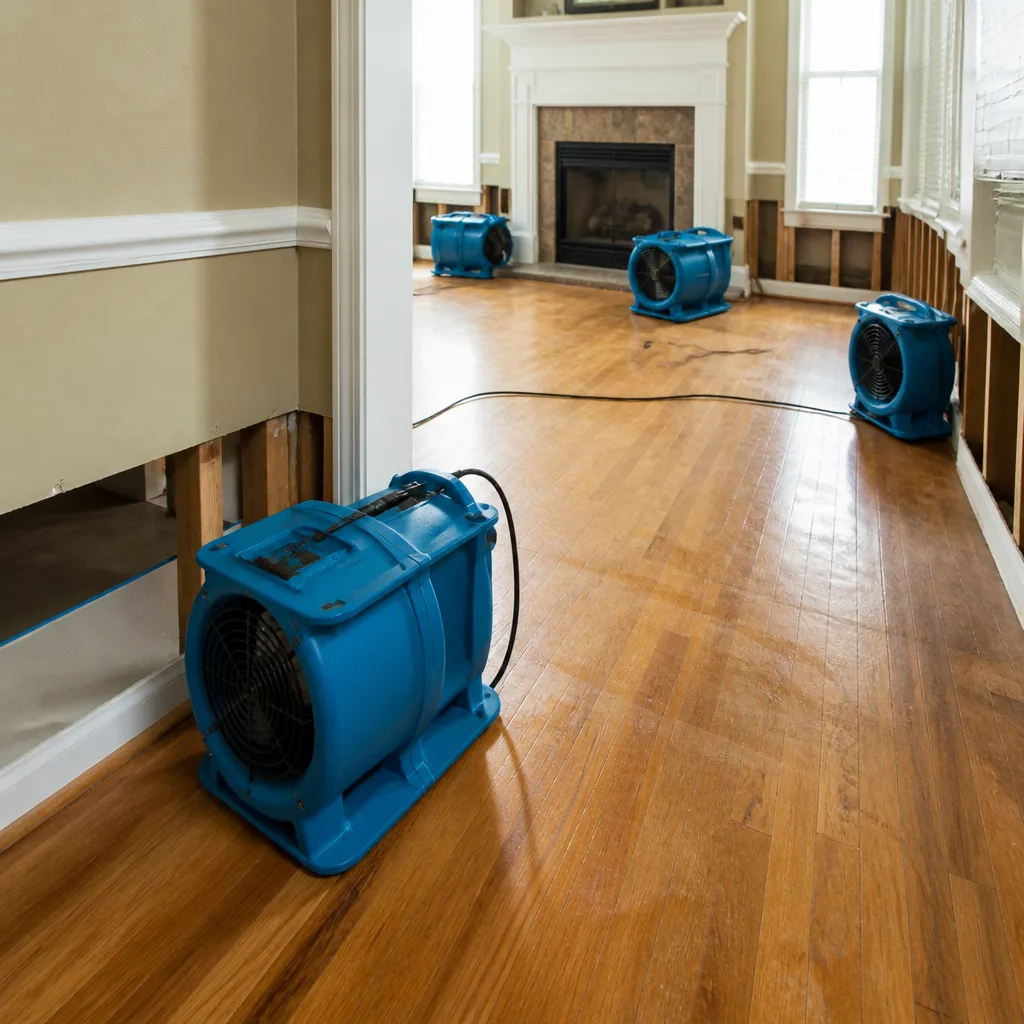 Water damage drying
 Fire & smoke cleanup
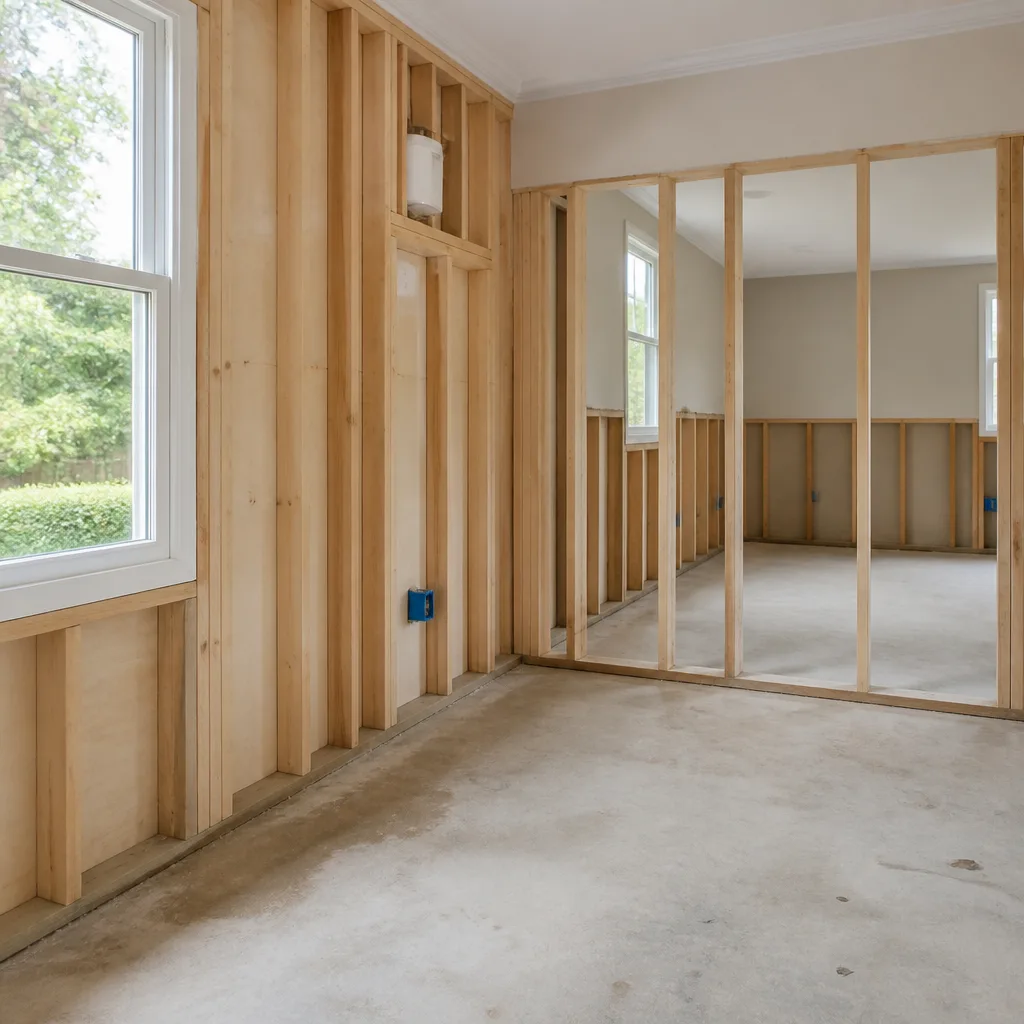 Mold remediation
 Storm response
 Sewage cleanup
 Reconstruction
Free visual inspection and a written scope of work before any mitigation begins - photos, moisture readings, and drying logs go in your claim file
The scope we write is the scope we bill. Anything new gets shown to you, in writing, before we touch it.
Get your free estimateDamage Restoration Warning Signs: A Rancho Cucamonga Homeowner’s Reference Guide
A musty smell in a room with no visible water stains is not a ventilation problem. It’s a late-stage mold indicator, which means moisture has been active inside a wall cavity or subfloor long enough for biological growth to establish itself. By the time you smell it, you’re past mitigation and into remediation. This guide teaches you to read the signals that trained technicians look for in Rancho Cucamonga homes, from the subtle to the structural, so you can act before a $900 drying job becomes a $14,000 rebuild.
Restoration work we handle
Quick Answer
The earliest water damage warning signs in a Rancho Cucamonga home are usually invisible: a 15-20% unexplained spike in your water bill, a persistent musty odor in one room, or paint that’s started to bubble on a ceiling below a bathroom. Visible staining means the problem is already days or weeks old. If you notice any of these, document what you see and call a restoration professional for a moisture assessment before the damage spreads into framing and subflooring. If you’re unsure whether to handle it yourself, read our DIY vs Professional Damage Restoration: The Rancho Cucamonga Homeowner’s Decision Guide first.
Table of Contents
- The Water Bill Warning: Reading Your Utility Statement Like a Leak Detector
- The Smell Map: What Different Odors Tell You About Hidden Moisture
- Visual Signals Beyond Staining: Paint, Baseboards, and Door Frames
- Using Touch and Sound to Find Moisture Without Equipment
- Rancho Cucamonga-Specific Signs That Get Blamed on Settling
- Mildew vs. Active Mold: Understanding the Urgency Gap
- What a Homeowner Can Safely Check, and What Requires a Professional
- Common Mistakes to Avoid
- When to Call a Professional
- Frequently Asked Questions
- The Bottom Line
The Water Bill Warning: Reading Your Utility Statement Like a Leak Detector
Most homeowners in Rancho Cucamonga discover water damage through their eyes or their nose. But the most reliable early-warning system you have is your water bill. A sudden 15-20% increase in water usage with no behavioral change, no new irrigation schedule, and no house guests, is a measurable red flag that something is leaking behind a wall, under a slab, or inside an appliance line. We’ve walked into homes where a pinhole leak in a copper supply line had been running inside a first-floor wall for three weeks before the homeowner noticed anything. The only signal was the bill.
Here’s how to read your statement effectively:
- Compare month-over-month, not year-over-year. A jump from December to January might be explained by a garden hose left on or holiday guests. A jump from March to April with no weather change is a leak signal.
- Look at the usage graph, not just the dollar amount. Rancho Cucamonga’s tiered water rates can mask a small leak as a rate change. The cubic feet or gallons used is the raw number that matters.
- Check for a continuous trickle indicator. Many local water meters have a small red triangle or digital flow indicator that spins whenever water moves through the meter. If it spins when every fixture in the house is off, you have a leak.
- Isolate zones. Turn off the irrigation system at the backflow preventer for one billing cycle. If usage drops significantly, the leak is in the landscape line, not the house.
A slab leak under a Rancho Cucamonga home built in the 1970s or 1980s, where copper supply lines run beneath the foundation, can waste 500 to 1,500 gallons per month before you feel a warm spot on the floor. By the time you feel it, the slab has been saturated for weeks. If your bill has jumped and you cannot find the source, call Water Damage Restoration in Rancho Cucamonga for a moisture survey. The equipment we use finds what your eyes can’t.
The Smell Map: What Different Odors Tell You About Hidden Moisture
Odor is the most underutilized diagnostic tool in a homeowner’s arsenal. Different smells map to different moisture problems, and understanding the difference tells you how urgent the situation is. Here’s what to know about the three most common moisture-related smells in Rancho Cucamonga homes:
- Damp earth or basement smell (low urgency): This is usually evaporation from a slow, low-volume moisture source: a crawl space with poor ventilation, a minor condensation issue around an AC register, or a slow drain pipe weep. It’s worth investigating, but it’s not a five-alarm fire. You can often trace it to a specific room or corner.
- Sharp, musty, locker-room smell (moderate urgency): This is mildew, the precursor to mold. It means organic material, usually drywall paper, has been wet long enough to support fungal growth, typically 48 to 72 hours. The smell concentrates in one area and gets stronger when you open a cabinet or closet. You’re still in the mitigation window, but that window is closing.
- Earthy, sour, or mushroom-like smell (high urgency): This is active mold growth, not just mildew. The microbial colony has established itself, is releasing spores, and the moisture source feeding it is ongoing. This smell doesn’t go away when you open windows; it’s embedded in the materials. At this stage, you need professional mold remediation, and Mold Remediation in Rancho Cucamonga should happen sooner rather than later, because the colony expands every day the moisture source remains active.
One thing we hear constantly from homeowners: “We thought it was just the house getting old.” Houses don’t smell musty from age. They smell musty from water. If you can smell it, the moisture has been present long enough for biology to take hold, and that is the single clearest sign that you’ve moved from prevention into restoration.
Visual Signals Beyond Staining: Paint, Baseboards, and Door Frames
Brown ceiling stains are the obvious signal everyone knows. But the more instructive signs, the ones that show up earlier and tell you more about where the water is actually traveling, are structural and cosmetic changes that most people dismiss as normal wear. Here are the visual signals we look for on every assessment:
- Paint bubbling or blistering on walls and ceilings: When moisture pushes through drywall, it lifts the latex paint film before it ever discolors it. Small, raised bubbles, especially on a ceiling below a bathroom or on a wall shared with plumbing, are a definitive moisture signal. The stain comes later.
- Baseboard separation: When a subfloor gets wet, the wood swells and pushes upward, forcing the baseboard off the bottom of the drywall. A visible gap along the bottom edge of your baseboard, especially in one room or along one wall, is not a caulking issue. It’s a swelling subfloor.
- Door frame racking: A door that suddenly sticks, rubs at the top corner, or won’t latch cleanly when it used to, often means the framing around the doorway has absorbed moisture and swelled. In a single-story Rancho Cucamonga home, this can point to a roof leak travelling down an interior wall to the door header.
- Grout cracking and tile displacement near water sources: Tile doesn’t crack on its own. When the substrate beneath it, usually cement board or mortar, gets wet and swells, the tile shifts. Hairline grout cracks around a tub surround or a kitchen backsplash, combined with any of the other signals on this list, point to water behind the tile.
- Nail pops in drywall: A small, circular bump in the drywall surface, often in a line, means the drywall is swelling and pushing the screw or nail head outward. One nail pop is normal settling. Several in a row, near a ceiling or a water source, is a moisture map of where the water is sitting.
These signals are the difference between catching a leak in week one and discovering it in week six, after the bottom plate of the wall has started to rot. In our experience, homeowners who read these signs early save themselves thousands in structural repair.
Using Touch and Sound to Find Moisture Without Equipment
You don’t need a moisture meter to locate a significant amount of water in your home. Your hands and ears are surprisingly effective diagnostic tools, and a five-minute walkthrough can help you decide whether to call a professional or keep watching. Here’s how to use them:
- Press your palm flat against drywall in suspect areas. Dry drywall feels uniform in temperature and firm to the touch. Wet drywall feels cool, even cold, to the palm, because water conducts heat away from your skin faster than dry material. It also gives slightly under firm pressure, like a cardboard box that’s been left in the rain.
- Walk barefoot across the floor in rooms below bathrooms or kitchens. A saturated subfloor transfers cold differently than a dry one. If one section of the floor feels noticeably colder than the surrounding area, especially in the morning before the house warms up, water may be sitting in the subfloor cavity.
- Tap on the drywall with your knuckle. Healthy drywall produces a sharp, hollow knock. Water-logged drywall produces a dull, flat thud, like knocking on a wet sponge. Move along the wall in a grid pattern and listen for a change in the sound profile.
- Listen for a hiss or faint running-water sound with all fixtures off. Stand in a quiet house, late at night, with no appliances running. If you hear a faint hiss, gurgle, or water-running sound inside a wall or floor, that’s a pressurized supply line leaking. This is an emergency-stage signal, and you should shut off the main water valve and call a professional immediately.
Touch and sound won’t tell you the exact moisture content of a wall cavity, and they won’t replace the IICRC-certified drying protocols and measurement tools that a professional restoration team uses. But they’ll tell you whether you have a problem worth investigating. If any of these tests comes back positive, the next step is a professional assessment with equipment, not a longer observation period. Our How to Hire a Damage Restoration Contractor in Rancho Cucamonga: A Step-by-Step Guide can help you choose the right team.
Rancho Cucamonga-Specific Signs That Get Blamed on Settling
Every region has its own building quirks, and Rancho Cucamonga is no exception. Homes here, particularly those built in the 1980s and 1990s in the Alta Loma and Etiwanda foothill neighborhoods, share common construction patterns that produce specific moisture signals. Unfortunately, these signs are frequently attributed to “the house settling” or “the dry climate” when they actually indicate active water intrusion.
Here’s what we see in Rancho Cucamonga homes that gets missed:
- Hairline cracks in interior stucco ceilings above bathrooms: Many foothill homes were built with stucco or textured plaster ceilings. When a toilet wax ring or tub overflow gasket fails slowly, water sits in the ceiling cavity and causes the plaster to micro-crack. The crack follows the path of the water, not the foundation. If the crack is above a bathroom and below another bathroom, it’s water, not settling.
- Tile displacement near water features in entryways and kitchens: Homes in the Victoria and Terra Vista neighborhoods frequently feature decorative tile work near entry fountains and kitchen wet bars. When these indoor water features develop a slow supply-line leak, the mortar bed beneath the tile absorbs the water and swells, causing individual tiles to rock or lift. This is not a grout problem; it’s a leak.
- Baseboard staining in upstairs hallways: Rancho Cucamonga’s hot, dry summers put real strain on HVAC condensate lines, and many are run through second-floor wall cavities. When a condensate drain clogs and overflows, the water runs down inside the wall and pools at the bottom plate, seeping out at the baseboard line. A brown stain along the bottom of a second-floor hallway baseboard is almost always an HVAC issue, not a roof leak.
These signs matter because they are early. A hairline ceiling crack above a bathroom is a $400 repair if caught in the first two weeks. Six months later, when the drywall finally gives way and the ceiling collapses onto the vanity, it’s a five-figure restoration that involves the ceiling, the vanity, and potentially the flooring below. If you live in an older Rancho Cucamonga home and you’ve noticed these signs, a professional assessment of your Flood Guard Water Damage home restoration needs is worth the time.
Mildew vs. Active Mold: Understanding the Urgency Gap
Homeowners often use “mildew” and “mold” interchangeably. They are not the same thing, and the distinction carries real urgency implications. Understanding the gap helps you know whether you’re dealing with a cleaning project or a remediation project.
Here’s the distinction in practical terms:
- Mildew: A surface-level fungal growth that appears as a powdery or fluffy patch, usually white, gray, or yellow, on non-porous or semi-porous surfaces like tile, grout, painted drywall, or shower curtains. It grows in high-humidity environments and can often be cleaned with antimicrobial products. Mildew does not penetrate the substrate; it lives on the surface. It signals a humidity problem, not necessarily a hidden water source.
- Active mold: A deeper fungal colonization that penetrates porous materials like drywall, wood, and insulation. It appears as green, black, or brown patches that may be fuzzy, slimy, or stain-like. Active mold means the material has been wet long enough for the colony to establish a root system, and the wall cavity or floor cavity behind it is almost certainly still wet. Cleaning the surface does nothing, because the colony lives inside the material.
The urgency gap is this: mildew, if addressed promptly with humidity control and surface cleaning, may not require professional intervention. Active mold requires professional remediation, because it means a water source is ongoing and the structural materials are compromised. If you scrape a small section of suspected growth and the discoloration extends below the surface, it’s active mold. We use IICRC-certified methodology for every mold project, because guessing at the scope of a mold problem is how hidden colonies get missed and reappear six months later.
What a Homeowner Can Safely Check, and What Requires a Professional
There is a line between responsible homeowner diligence and dangerous territory. Knowing where that line sits protects both your safety and the structural integrity of your home. Here’s a straightforward breakdown:
Safe for a homeowner to check:
- Reading the water bill and comparing month-over-month usage
- Visual inspection of accessible areas: baseboards, ceiling corners, under sinks, around toilets
- Pressing drywall and tapping walls to feel for softness or temperature changes
- Checking HVAC condensate drain lines for visible clogs or overflow
- Documenting visible damage with photos and notes for insurance purposes
Leave to a professional:
- Opening wall cavities, pulling back flooring, or removing baseboards to trace a leak
- Handling any electrical panel, wiring, or outlet that may have been exposed to water
- Disturbing mold that covers more than 10 square feet or that is growing in an enclosed space
- Working on or near gas-fired water heaters or boilers
- Cutting into drywall or flooring that may contain asbestos or lead paint, common in pre-1978 Rancho Cucamonga homes
The safety caveat here applies specifically to the electrical and gas components. Water and electricity do not mix, and a wet wall cavity with live wiring is a genuine hazard. Gas lines, similarly, require specialized training to assess safely. If your moisture issue is anywhere near an electrical panel, a gas appliance, or a forced-air unit, shut off the relevant power or gas at the source and call a professional. This is not a place for experimentation.
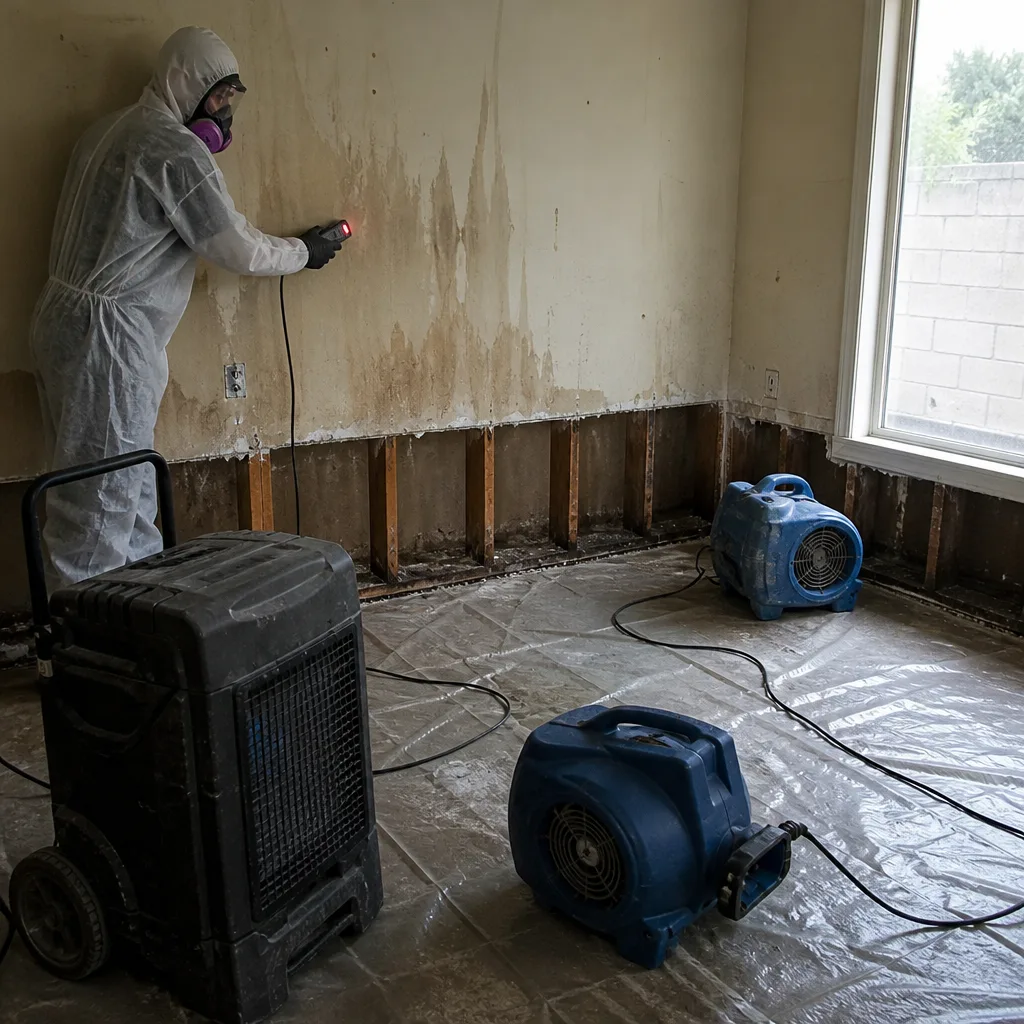
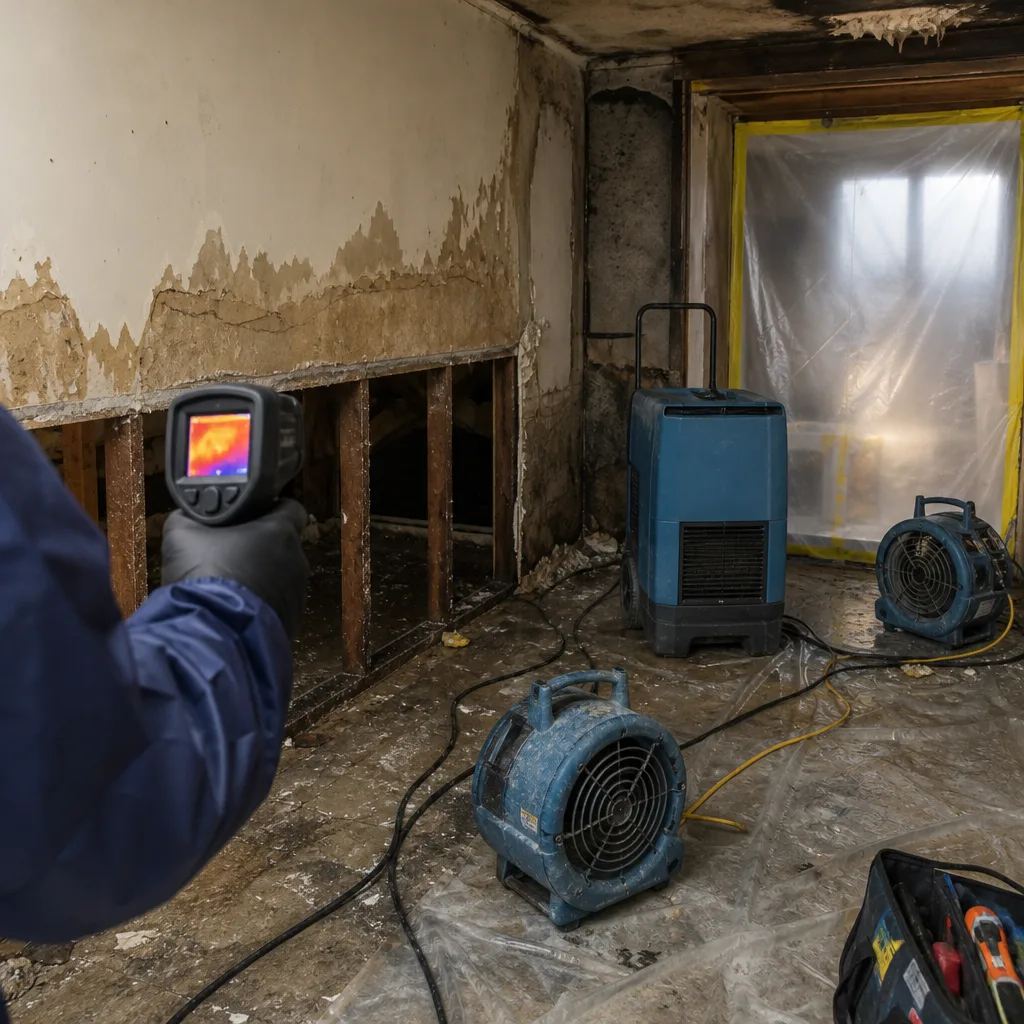
For the checkable items, we recommend starting with a DIY walkthrough and documenting everything you find. Then bring in a professional team for the assessment. Flood Guard uses commercial-grade moisture detection equipment, including Dri-Eaz measurement tools, to quantify what’s actually inside the wall cavity. That measurement, not a visual estimate, is what guides the drying plan.
One More Warning Category: Fire Damage That Hides Water Damage
This guide is primarily about water, but since we’re covering restoration warning signs, there’s a category that catches Rancho Cucamonga homeowners off guard: water damage that arrives after a fire. When a home in the Etiwanda area experiences a kitchen fire or a garage fire, the fire department’s response involves hundreds of gallons of water, and the structural drying that follows is just as critical as the fire cleanup itself. If you’ve had a fire, the water from suppression efforts is already working its way into your framing within hours. Fire Damage Restoration in Rancho Cucamonga requires addressing both the burn damage and the water damage simultaneously, because the secondary moisture is what causes the long-term rot and mold that follows a fire by weeks or months. If you smell smoke and mustiness together, you have both problems at once.
Common Mistakes to Avoid
- Waiting to see if the smell or stain goes away on its own. Moisture problems do not self-resolve. Every day a leak remains active, the damage radius expands, and the remediation cost increases. In Rancho Cucamonga’s dry climate, surface water may evaporate quickly, which masks the problem while the wall cavity continues to hold moisture. The dry air is actually working against you, because it hides the evidence.
- Painting over water stains without addressing the source. A coat of stain-blocking primer makes the problem invisible, but the moisture behind the drywall continues to degrade the framing. The stain comes back, darker and larger, and by then the wall cavity may be fully colonized with mold.
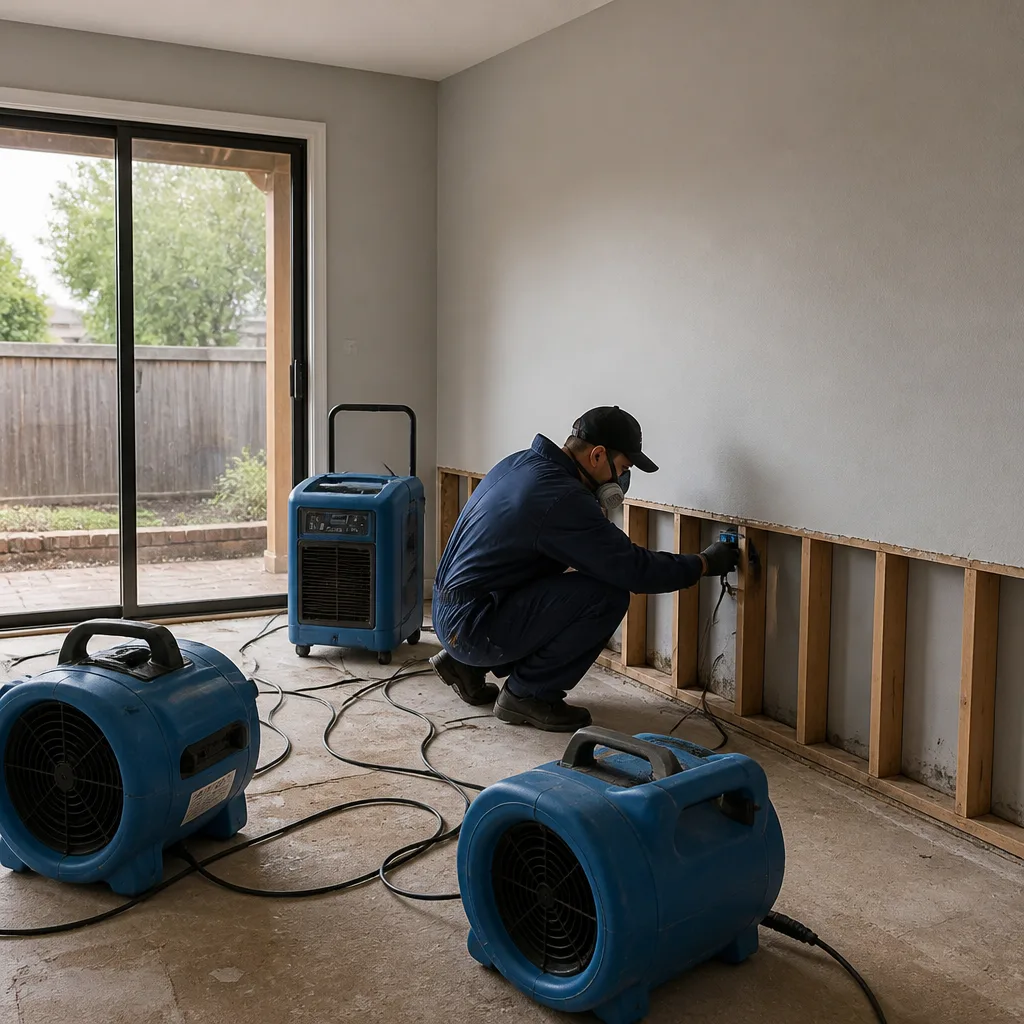
- Running a household fan on a wet area and calling it dried. A box fan moves surface air and might dry the top millimeter of drywall. It does not dry the insulation, the framing, or the wall cavity. Proper structural drying requires professional-grade air movers and dehumidifiers, and the process is measured with moisture meters at multiple depths.
- Assuming one visible stain equals one leak. Water travels along framing, across drywall seams, and down wall cavities. A stain on the first-floor ceiling may originate from a leak on the second-floor supply line, three rooms away. Chasing the stain without tracing the path leads to fixing the wrong thing.
- Treating all mold as a homeowner-cleaning project. Surface mold on tile is one thing. Active mold in a wall cavity is a different project entirely, and disturbing it without proper containment can spread spores throughout the house. The 10-square-foot rule is the generally accepted threshold: below it, cleaning may be appropriate; above it, professional remediation with containment is necessary.
- Skipping the written scope before work starts. A handshake estimate that doubles halfway through the job is a known failure mode in this industry. A professional restoration team agrees on a written scope of work, with measurements and line items, before any equipment is deployed. If a contractor won’t put it in writing, that’s a signal about how the rest of the job will go.
When to Call a Professional
Call a professional restoration team when any of these is true: your water bill has jumped 15% or more with no explanation, you smell a persistent musty odor that doesn’t clear with ventilation, you can feel soft spots in drywall or flooring, you see paint bubbling on a ceiling below plumbing, or you have visible mold that covers more than a dinner plate. Also call if you’ve had a plumbing leak that ran for more than 24 hours before it was fixed, because the wall or floor cavity is now holding moisture even if the surface looks fine. Flood Guard Water Damage offers free estimates in Rancho Cucamonga. Call (844) 716-1094, and we’ll send a certified technician with professional moisture detection equipment to measure what’s actually happening inside your walls.
Frequently Asked Questions
Look for the secondary signals: a sudden water bill increase of 15-20%, a musty smell that doesn’t clear with ventilation, paint bubbling on ceilings below bathrooms, baseboards separating from the wall, or doors that suddenly stick. Any of these, alone or in combination, warrants a professional moisture assessment with measurement equipment.
In Rancho Cucamonga homes, a persistent musty smell is almost always moisture-related. It can come from a damp crawl space, a clogged HVAC condensate line, or a slow plumbing leak in a wall cavity. If the smell gets stronger when you open cabinets or closets, the moisture source is inside a confined space.
Small, contained drying jobs, like a single wall cavity after a supply-line leak, typically range from $800 to $1,800. Larger events, like a bathroom overflow that saturates a ceiling and subfloor, run $3,000 to $7,000. Full-scale water damage restoration after a major leak or flood can run $10,000 to $20,000 or more, depending on the square footage and the materials involved. Call (844) 716-1094 for an exact quote after a moisture assessment. Estimates are free.
Most homeowners policies cover sudden and accidental water damage, like a burst pipe or an overflowing tub. They typically do not cover gradual leaks that have been ongoing for weeks or months. If you’re filing a claim, document everything with photos, and work with a restoration team that provides photo-documented assessments and direct adjuster coordination, because the evidence package is what determines whether your claim is approved.
For active water events, like a burst supply line or a sewage backup, a serious restoration company responds within hours, not days. The first 24 hours determine how much drying is needed, because saturated drywall and insulation degrade quickly. If a company can’t dispatch same-day for an active leak, keep calling.
If the mold covers less than 10 square feet and is on a non-porous surface like tile or glass, surface cleaning with an antimicrobial product may be adequate. If it’s on drywall, wood, or insulation, or if it covers a larger area, the colony has penetrated the material and surface cleaning will not resolve it. The material needs to be removed and replaced, and the moisture source behind it needs to be identified and eliminated.
Injectidry is a specialized drying system that forces dry air into wall cavities, under flooring, and into other enclosed spaces without cutting open the drywall or pulling up the floor. It matters because it can dry a wet wall cavity in place, which means less demolition, less reconstruction, and a lower total repair bill. Not every home is a candidate, but when the conditions are right, it’s the difference between a $3,000 patch-and-paint job and a $12,000 wall rebuild.
The Bottom Line
Water damage in a Rancho Cucamonga home is almost always older than it looks. The visible stain, the warped baseboard, the sticking door, these are all late-stage signals of a moisture problem that started days or weeks earlier. The homeowners who catch the early signs, the water bill spike, the faint musty smell, the cool spot on the drywall, are the ones who spend hundreds on mitigation instead of thousands on reconstruction. Read the secondary signals. Document what you find. If any of the warning signs in this guide are present in your home, call (844) 716-1094 for a free professional assessment. The earlier you catch it, the less it costs.
Written by the team at Flood Guard Water Damage, serving Rancho Cucamonga since 2018.
See the difference
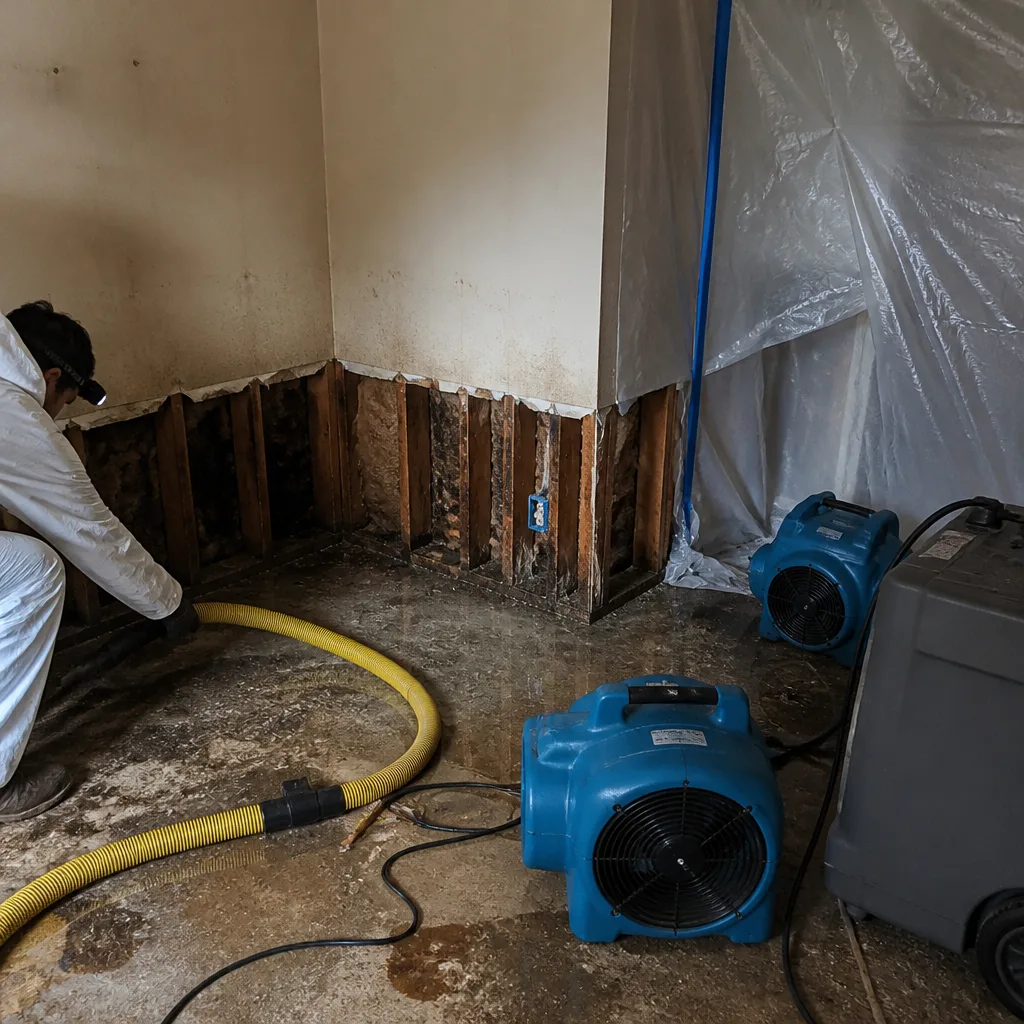 Before
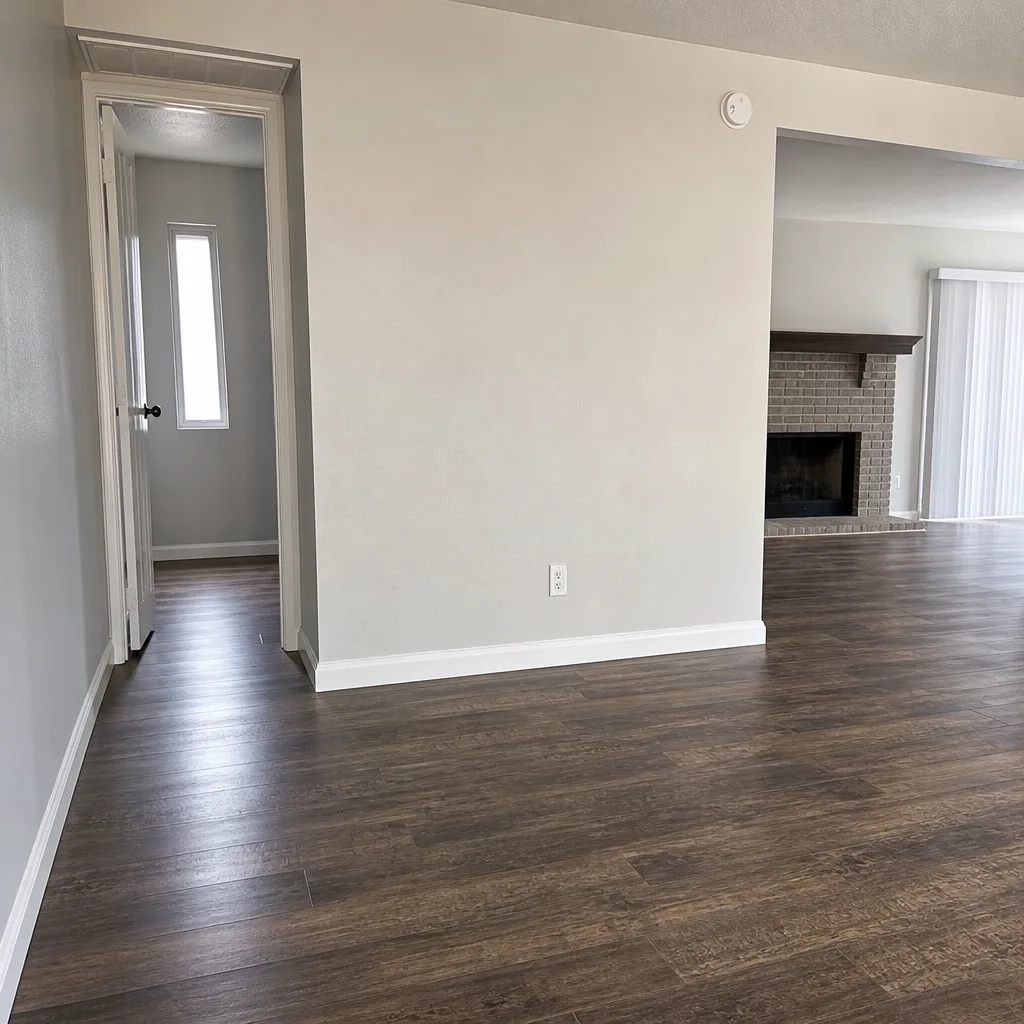 After
 Before
 After
 Before
 After